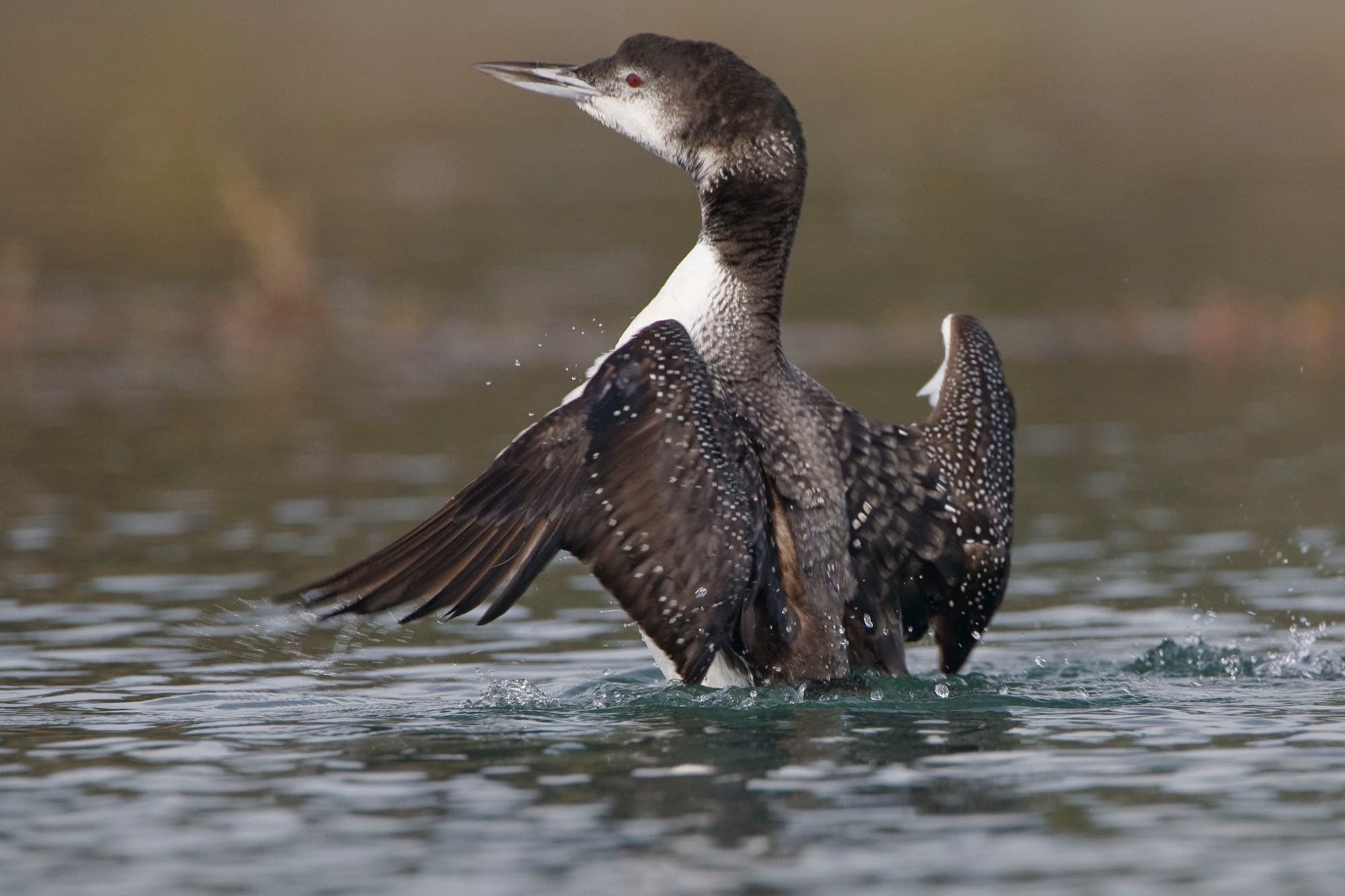
Common Loon
Gavia immer
Drawn from a named source but not independently confirmed. Double-check before relying on it.
Protected status under the Migratory Bird Treaty Act is well-established, generally-known federal law, not specific to a single fetched page. Identification/confusion-risk facts drawn from Maine Audubon's 'Commonly Misidentified Species: Diving Birds' guide and Bird Collective's loon-vs-duck comparison via live search synthesis — a genuine hunter-education-oriented source, not this project's own invention.
A federally protected diving bird — not a legal migratory game bird — seeded here specifically because it is a well-documented, real identification hazard: hunters can and do confuse loons (especially in flight or while diving) with legal diving ducks and mergansers, particularly common mergansers in breeding-like plumage.
Field marks
- Feet extend visibly beyond the tail in flight, giving a wedge-shaped rear silhouette unlike any duck.
- Slower wingbeat and a low-slung head-and-neck posture in flight, distinct from a duck's faster wingbeat and more level carriage.
- Common merganser (a real, legal species, see that entry) is the species most often mistaken for a loon; the loon's black bill (vs. a male common merganser's red bill) and lack of white wing patches are the most reliable distinctions.
- Exceptionally strong diver — can reach depths around 200 feet, far beyond typical diving-duck depths (most diving ducks manage roughly 10 feet; mergansers around 40 feet; eiders, the deepest-diving ducks, a bit over 60 feet) — not a field mark useful in the moment, but indicative of how different its underwater behavior is from any legal target species.
- At a distance, also confusable with double-crested cormorant (which sits lower with an upward-tilted bill and often perches on pilings with wings spread to dry) and the smaller, compact protected grebes — see that entry for the full 3-way distinction.
- Habitat
- Large lakes, bays, and coastal waters in winter — regularly present on the Chesapeake Bay and Hampton Roads' larger open-water areas in the same season and habitat type many legal diving ducks use.
Conservation context
Protected under the Migratory Bird Treaty Act; not managed as a game species anywhere in its range. Sensitive to water quality, mercury contamination, and human disturbance on its (mostly northern) breeding lakes.
Similar species — check before you shoot
Identification alone never establishes that a bird may legally be taken. Confirm species (and sex, where a sub-limit depends on it) before shooting.
Ethical shot selection: If there is any uncertainty whether a diving bird is a loon or a legal duck/merganser, do not shoot. The bill color, silhouette, and flight posture differences above are the standard field cues cited in hunter-education material for this exact confusion case.
This page is educational and does not certify that any specific bird may be legally taken at any specific time or place. Always confirm the current season, bag limit, and permit requirements at Licensing & Regulations →