Double-crested Cormorant
Nannopterum auritum
Drawn from a named source but not independently confirmed. Double-check before relying on it.
Identification features (posture, bill shape/angle, wings-spread drying behavior) directly confirmed against Cornell's All About Birds identification page. Federal protection under the Migratory Bird Treaty Act is well-established general knowledge; the depredation-permit carve-out is real (a documented USFWS program) but this project has not independently verified its exact current scope — stated generally rather than in specific operative detail. Added in the Regional Species Completeness, Phase 2 pass, promoted from the framework's own pre-existing draft entry — the framework's own loon-vs-cormorant-vs-grebe LOOKALIKE_GROUPS cluster already flagged this species as the region's most common member of that confusion group.
An extremely common protected waterbird throughout Hampton Roads year-round, frequently misidentified as a duck or loon at a distance — the most commonly-encountered member of this guide's loon/cormorant/grebe protected-lookalike group.
Field marks
- Long, kinked neck and small head with a thin, strongly hooked bill roughly the length of the head — a silhouette unlike any duck.
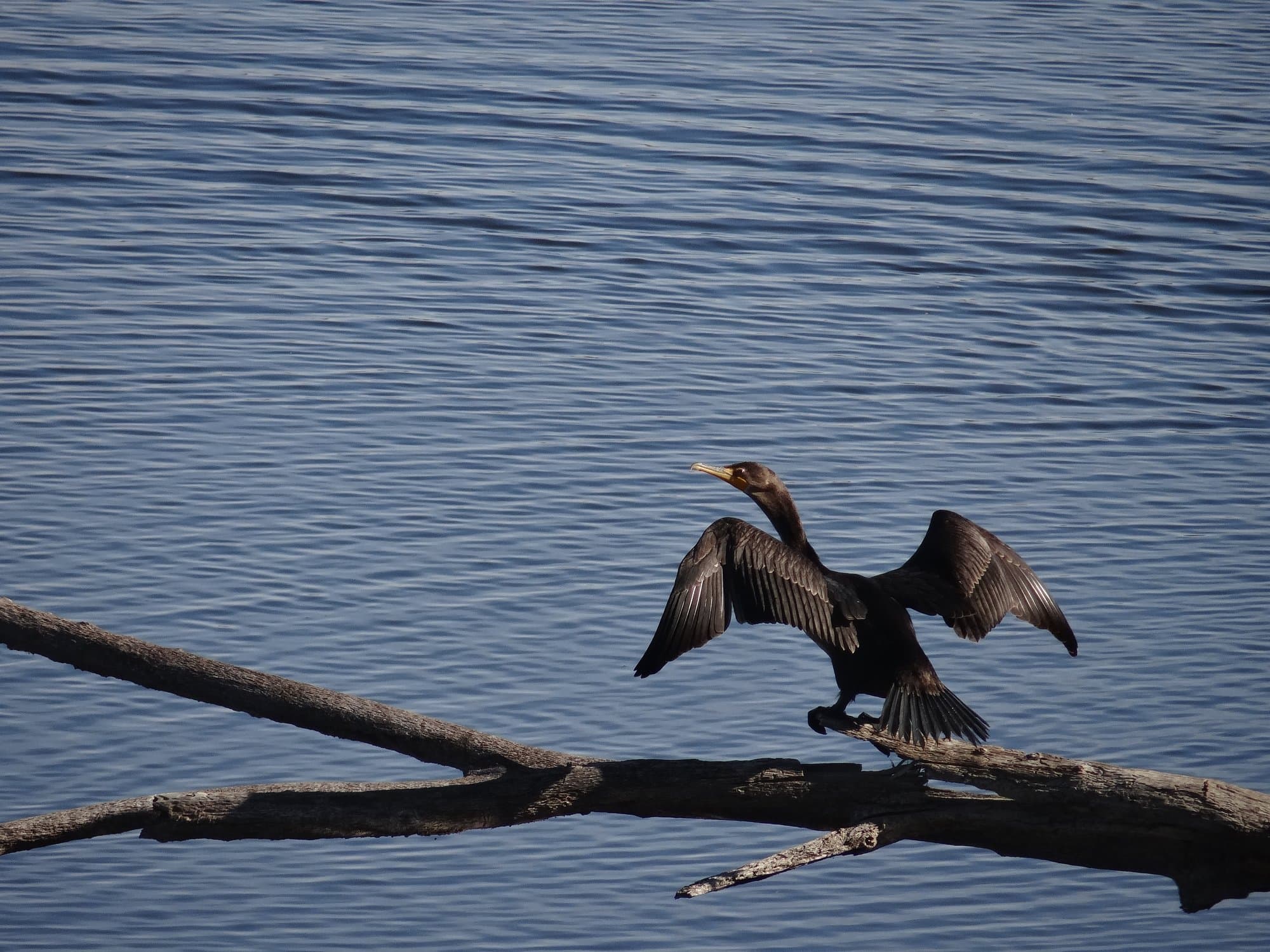
- Overall brown-black plumage with a small patch of yellow-orange skin on the face.
- Sits low in the water with the bill typically tilted upward — the field posture that separates it from a loon, which rides higher with a straight, dagger-like bill held level.
- Frequently perches on pilings, channel markers, or dead trees with wings held spread open to dry — a behavior no duck or loon shares, and one of the most reliable at-a-glance identifiers in Hampton Roads.
- Habitat
- Pilings, channel markers, and open Bay water throughout Hampton Roads year-round — one of the most frequently seen waterbirds in the region regardless of season.
- Flight profile
- Forms loose, irregular V-formations in migratory flocks; flies with constant wingbeats and a bulky, front-heavy appearance, unlike a duck's more streamlined flight silhouette.
Conservation context
Protected under the Migratory Bird Treaty Act; a native species whose population had been reduced by pesticide-era (DDT) impacts and has substantially recovered under federal protection.
Similar species — check before you shoot
Identification alone never establishes that a bird may legally be taken. Confirm species (and sex, where a sub-limit depends on it) before shooting.
Ethical shot selection: The wings-spread drying posture and upward-tilted bill are the fastest, most reliable field cues that a distant dark waterbird is a cormorant, not a duck or loon — if either is unclear, do not shoot.
This page is educational and does not certify that any specific bird may be legally taken at any specific time or place. Always confirm the current season, bag limit, and permit requirements at Licensing & Regulations →