White-winged Scoter
Melanitta deglandi
Drawn from a named source but not independently confirmed. Double-check before relying on it.
Identification/population-concentration facts drawn from Cornell's All About Birds and Audubon's field guide via live search synthesis across multiple independent sources — the 70%-of-Atlantic-population-in-Chesapeake-Bay figure is a real, notable statistic worth double-checking against a primary Sea Duck Joint Venture or USFWS status assessment in a future research pass.
Legal status: A legal migratory game bird, hunted during Virginia's regular duck season (not a separate sea-duck season) under a combined sub-limit shared across all three scoter species — DWR's own page: "4 total sea ducks (no more than 3 scoters, 3 eiders [only 1 hen], 3 long-tailed ducks)" — see the seeded ducks-2026-2027 HuntingSeason record. The 3-scoter cap is combined across surf/black/white-winged scoter, not 3 of each — verify current limits directly with DWR before hunting.
The largest of Virginia's three scoter species, and the one most concentrated in the Chesapeake Bay specifically — roughly 70% of the entire Atlantic-coast wintering population uses the Bay and southern New England combined.
Field marks
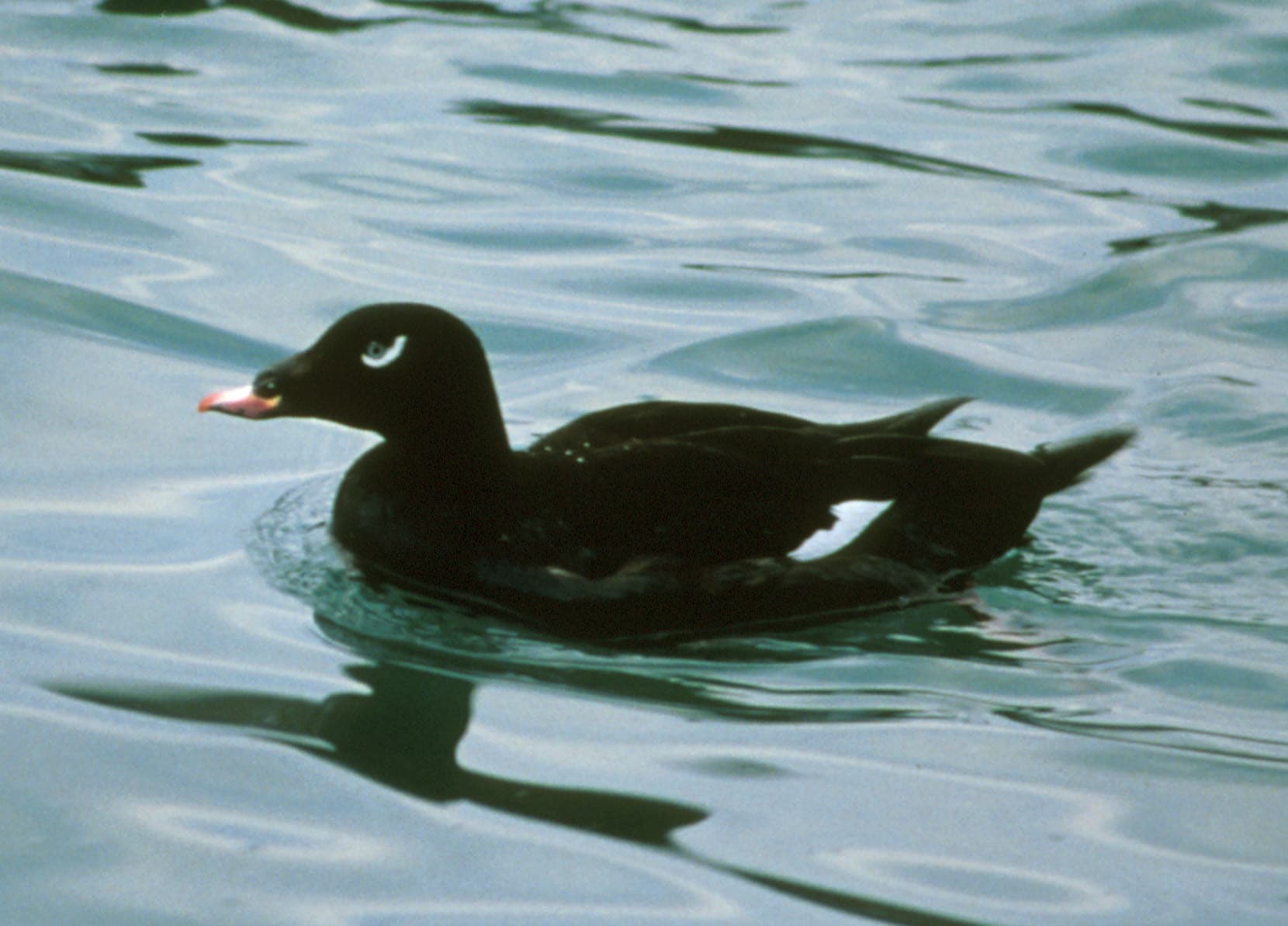
- A large white wing patch, visible on the water and unmistakable in flight — the single mark separating this species from both surf and black scoter, which show entirely dark wings.
- A comma-shaped white mark around and behind the eye on the male.
- Black feathering extends onto the bill, with an orange tip; bright orange-red feet.
Male, female, and seasonal plumage
- Female
- Dark brown with a paler belly, the same large white wing patches as the male, and two smudgy white face patches with a dark bill.
- Habitat
- Coastal bays and nearshore ocean; the Chesapeake Bay specifically is one of the species' most important wintering concentrations continent-wide.
Conservation context
With roughly 70% of the Atlantic wintering population concentrated in the Chesapeake Bay and southern New England, this species' status is unusually tied to Bay water quality and habitat condition specifically, more so than the more widely-distributed surf and black scoters.
Similar species — check before you shoot
Identification alone never establishes that a bird may legally be taken. Confirm species (and sex, where a sub-limit depends on it) before shooting.
This page is educational and does not certify that any specific bird may be legally taken at any specific time or place. Always confirm the current season, bag limit, and permit requirements at Licensing & Regulations →