Black Scoter
Melanitta americana
Drawn from a named source but not independently confirmed. Double-check before relying on it.
Identification facts drawn from multiple independent sources via live search synthesis, not one direct authoritative-page fetch — a comparatively thinner sourcing base than most other species in this batch; a future pass should directly fetch Cornell's or Ducks Unlimited's own black scoter page rather than relying on synthesis alone. `foodUseStatus` matches the other two scoters' eat-with-caution reasoning.
Legal status: A legal migratory game bird, hunted during Virginia's regular duck season (not a separate sea-duck season) under a combined sub-limit shared across all three scoter species — DWR's own page: "4 total sea ducks (no more than 3 scoters, 3 eiders [only 1 hen], 3 long-tailed ducks)" — see the seeded ducks-2026-2027 HuntingSeason record. The 3-scoter cap is combined across surf/black/white-winged scoter, not 3 of each — verify current limits directly with DWR before hunting.
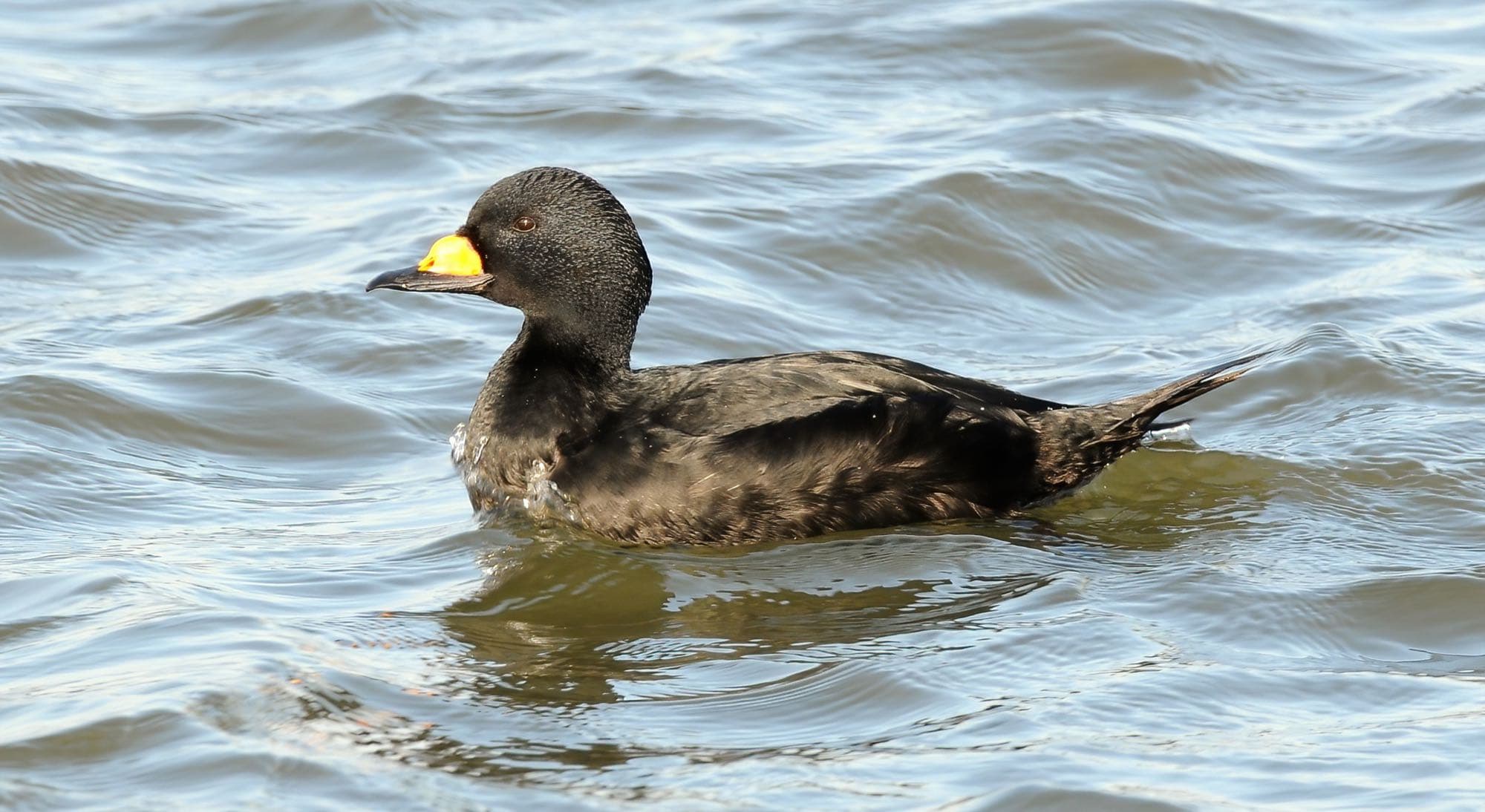
The plainest of Virginia's three scoter species — entirely black on the male with no white wing patch or head patches, distinguished mainly by its bulbous, brightly colored bill knob.
Field marks
- Adult male is entirely black with a very bulbous bill, mostly yellow-orange at the base — the single most useful mark at any distance, since this species otherwise lacks the bold white patches surf and white-winged scoters show.
- Entirely dark wings, like surf scoter (unlike white-winged scoter's white wing patch).
- Rounder head than the similarly dark-winged surf scoter, and females lack surf scoter's white face patches, instead showing a darker crown against a paler face.
- Habitat
- Coastal bays and nearshore ocean waters in winter.
Similar species — check before you shoot
Identification alone never establishes that a bird may legally be taken. Confirm species (and sex, where a sub-limit depends on it) before shooting.
Ethical shot selection: Distinguishing black scoter from a dark-morph or distant surf/white-winged scoter takes real care — the bill-knob color and head shape are the most reliable marks; when uncertain which scoter species (or sex) is in range, let the bird pass.
This page is educational and does not certify that any specific bird may be legally taken at any specific time or place. Always confirm the current season, bag limit, and permit requirements at Licensing & Regulations →