Snow Goose
Anser caerulescens
Drawn from a named source but not independently confirmed. Double-check before relying on it.
Population/flyway facts drawn from state wildlife-agency and outdoor-media coverage of the light-goose conservation order via live search synthesis, not a direct fetch of the eCFR text itself (which returned a bot-protection redirect during this build — see WATERFOWL_EXPANSION_PLAN.md §3). Regular-season bag-limit facts are separately, directly sourced to this project's own Light Goose Season HuntingSeason record via a direct DWR fetch.
Legal status: A legal migratory game bird in Virginia. The regular light-goose season carries a notably high daily bag limit and no possession limit (see the Light Goose Season record) — a direct consequence of the species' overabundance-management status, not an indication the species is unregulated. A separate federal spring Light Goose Conservation Order (50 CFR 21.180) exists outside the regular season framework with its own distinct rules (including extended shooting hours) — this project has not independently seeded that separate program's Virginia-specific details; verify directly before participating in it.
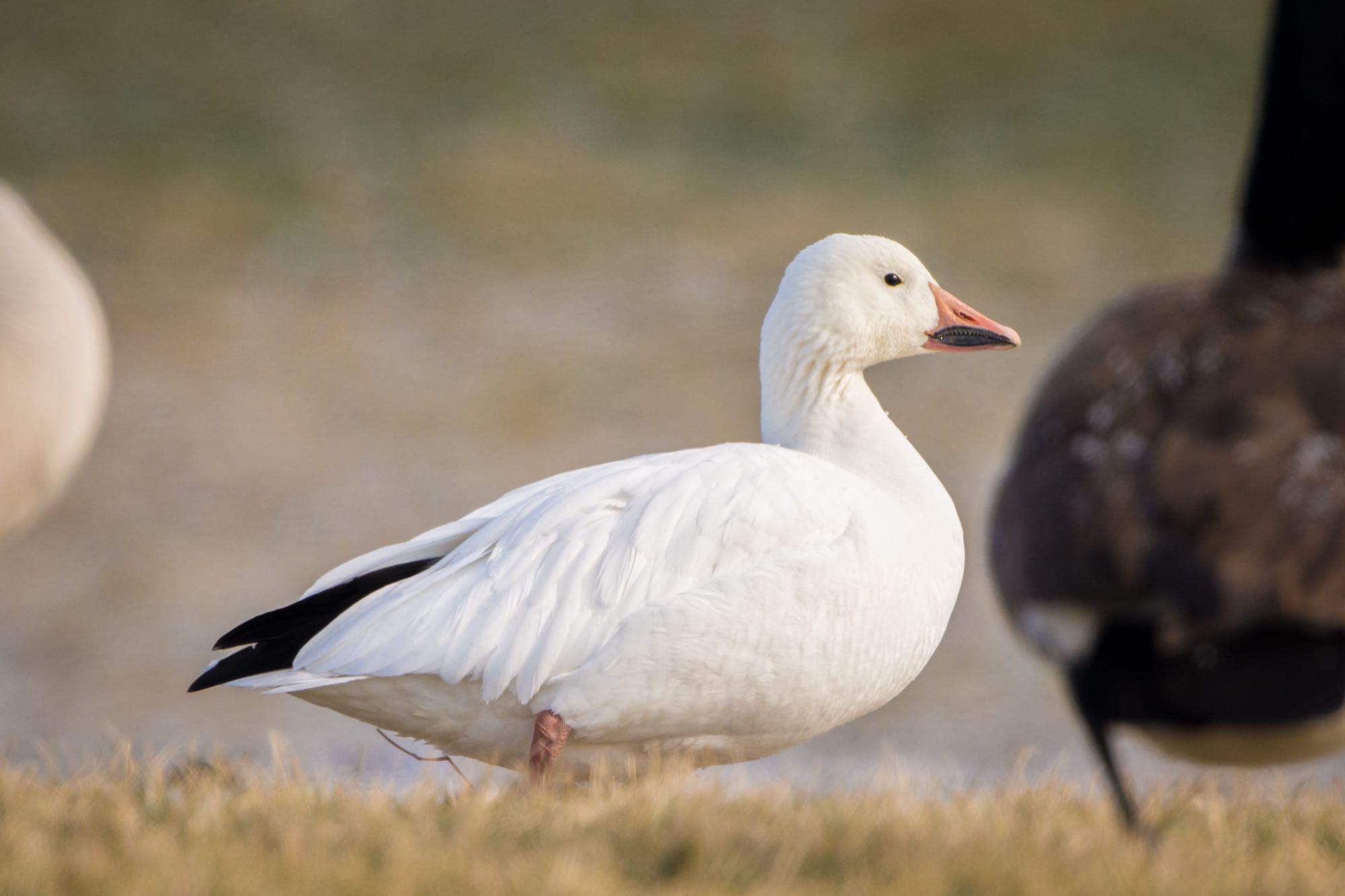
A bright white goose (with a dark 'blue' color-morph) that winters in large, often spectacular flocks — managed in Virginia under both a regular season and a separate federal conservation-order framework due to overabundance on the breeding grounds.
Field marks
- White-morph birds are bright white overall with black wingtips, visible both on the water and in flight.
- Pink bill with a dark 'grinning patch' along the cutting edge.
- A less common dark ('blue') color morph exists, with a white head and dark body.
- Habitat
- Open fields, marshes, and large bodies of water in winter; frequently forages on agricultural land alongside marsh roosting sites.
- Flock behavior
- Highly gregarious, often forming very large, dense flocks — thousands of birds may winter or stage together, especially compared to the smaller family groups typical of Canada geese.
- Vocalizations
- A high-pitched, nasal, repeated 'houk' call, often heard from large flocks well before they're visible.
Migration & seasonal context
In the Atlantic Flyway, roughly 95% of 'light geese' (snow, blue-morph, and Ross's geese collectively) are greater snow geese, with lesser snow geese under 5% and Ross's geese a small remainder. The Atlantic Flyway light-goose population grew from roughly 50,000 birds in the mid-1960s to over a million in recent years (a 2024 estimate put the population at 628,000); wildlife managers have targeted a 500,000–750,000 population goal given documented breeding-ground habitat damage from overabundant light geese.
Conservation context
Population overabundance — not scarcity — is the actual management concern for this species: light geese have caused well-documented damage to Arctic breeding-ground vegetation, which is why federal frameworks (including a spring conservation order distinct from the regular season) exist specifically to allow additional harvest, unlike the conservation-driven, harvest-restricting frameworks that apply to most other waterfowl on this list.
Similar species — check before you shoot
Identification alone never establishes that a bird may legally be taken. Confirm species (and sex, where a sub-limit depends on it) before shooting.
This page is educational and does not certify that any specific bird may be legally taken at any specific time or place. Always confirm the current season, bag limit, and permit requirements at Licensing & Regulations →