Ring-necked Duck
Aythya collaris
Drawn from a named source but not independently confirmed. Double-check before relying on it.
Identification/habitat facts drawn from Cornell's All About Birds and Project Upland via live search synthesis across multiple independent sources. Directly relevant to this project's own Ragged Island WMA record, whose own DWR page lists scaup among the species using that area — ring-necked duck was not itself named there, so no HuntingArea speciesAllowed entry was added without that direct confirmation.
Legal status: A legal migratory game bird in Virginia during the open duck season, under the general duck bag limit — verify current sub-limits, if any, directly with DWR before hunting.
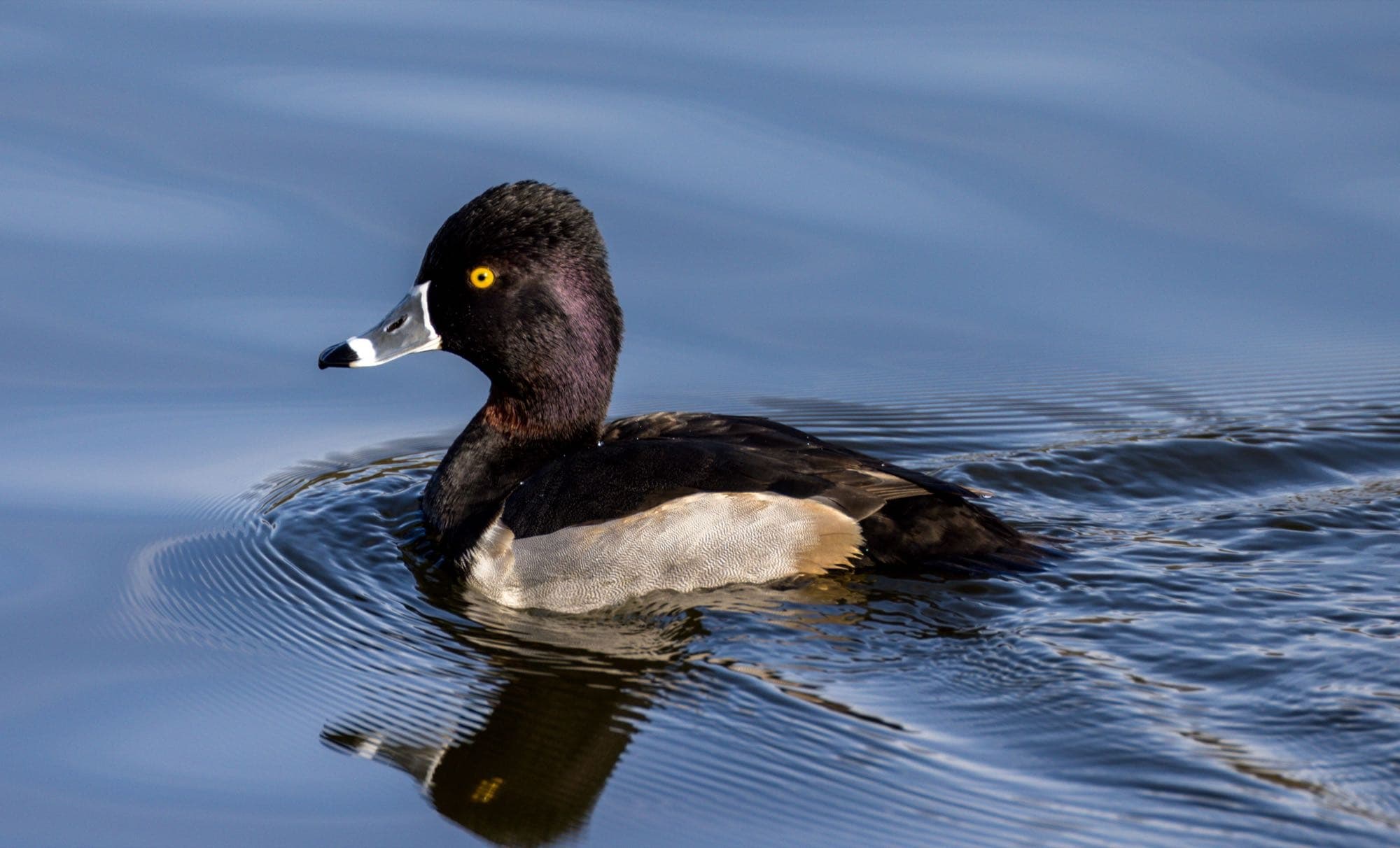
A compact diving duck whose namesake neck ring is nearly impossible to see in the field — the peaked head shape and bold white bill ring are the marks that actually work at a distance.
Field marks
- Peaked, angular head shape with a sloping forehead — distinct from the rounder heads of scaup.
- A bold white ring near the tip of the bill is the most reliable field mark — far easier to see than the faint brown neck ring the species is named for.
Male, female, and seasonal plumage
- Male
- Black-and-gray body with a black back, a white spur of color on the chest ahead of the folded wing, and the peaked black head.
- Female
- Rich brown overall with a pale cheek patch and a whitish eye-ring/bill-ring pattern.
- Habitat
- Unusually for a diving duck, prefers shallow water — typically 3 to 5 feet deep — in freshwater marshes, beaver ponds, flooded agricultural fields, and brackish estuaries, rather than open, deep water.
- Feeding behavior
- Dives for mollusks, aquatic invertebrates, and submerged vegetation in shallow water, requiring less diving effort than most other diving ducks.
Migration & seasonal context
Present in Virginia primarily October through April; a real, if modest, presence on winter checklists statewide.
Similar species — check before you shoot
Identification alone never establishes that a bird may legally be taken. Confirm species (and sex, where a sub-limit depends on it) before shooting.
This page is educational and does not certify that any specific bird may be legally taken at any specific time or place. Always confirm the current season, bag limit, and permit requirements at Licensing & Regulations →