Greater Scaup
Aythya marila
Drawn from a named source but not independently confirmed. Double-check before relying on it.
Identification/distribution facts drawn from the Chesapeake Bay Program's own field guide, Cornell's All About Birds, and Audubon's greater-vs-lesser scaup comparison via live search synthesis across multiple independent sources.
Legal status: A legal migratory game bird in Virginia during the open duck season — this project's own DWR research did not isolate a scaup-specific sub-limit distinct from the general duck bag limit; verify the current season's exact figure directly with DWR.
The larger, more saltwater-associated cousin of the lesser scaup already on this site — genuinely difficult to separate from lesser scaup without checking head shape and bill detail side by side.
Field marks
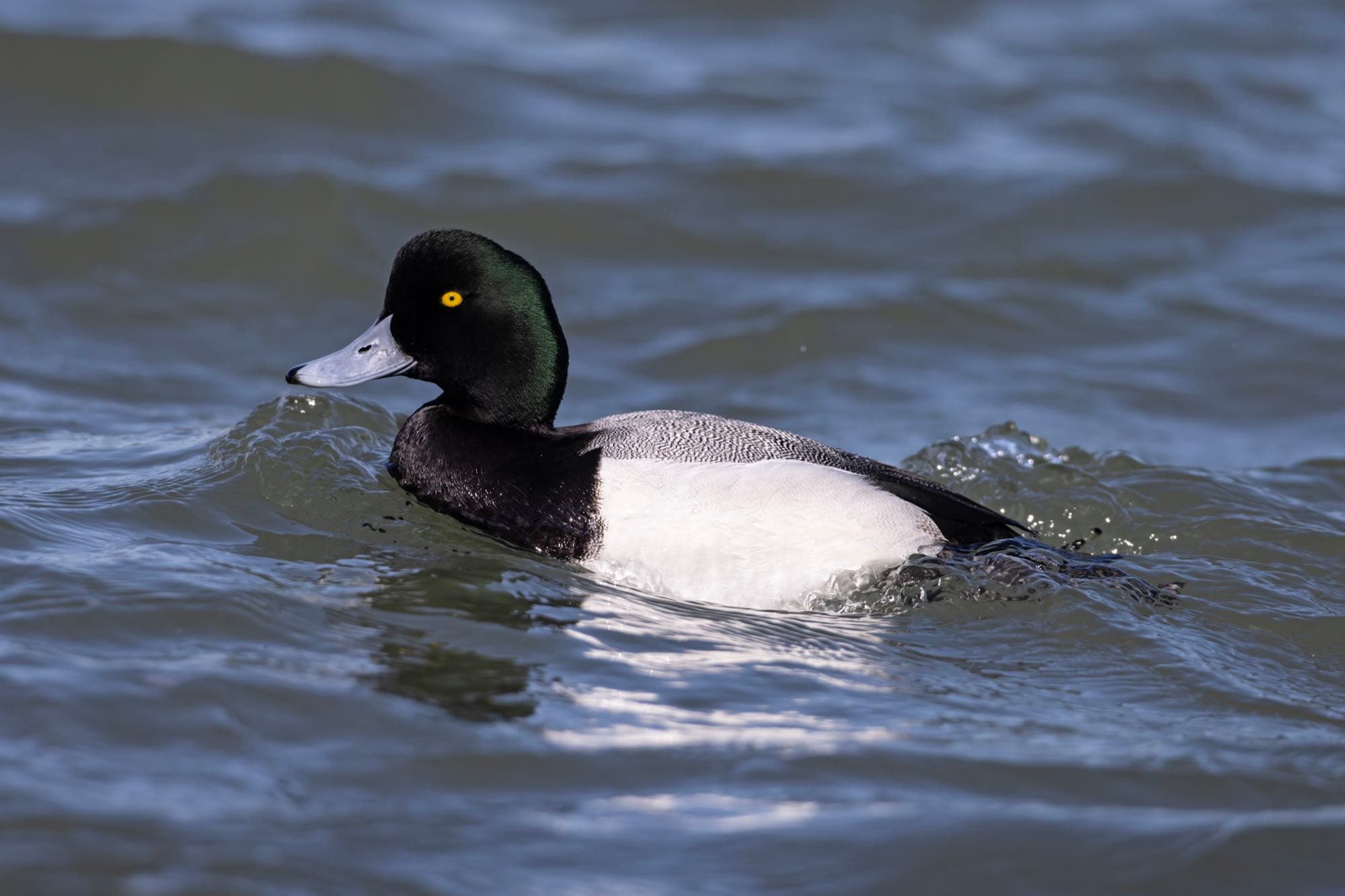
- Rounded, evenly curved head shape ('bowler hat'), vs. lesser scaup's peaked crown ('top hat with a tuft') — the single most reliable mark, best judged when the bird is resting or preening.
- A wider bill with a larger black nail (bill tip) than lesser scaup.
- In flight, white extends further into the primaries (not just the secondaries) compared to lesser scaup — a real but distance-dependent mark.
- About 20% larger-bodied than a lesser scaup.
Male, female, and seasonal plumage
- Male
- Black head with green iridescence in good light (vs. lesser scaup's more purplish head gloss) — a subtle mark, not reliable alone.
- Female
- Brighter yellow eye than a lesser scaup hen's amber-to-orange eye.
- Habitat
- Favors saltwater and larger open bodies of water more than lesser scaup, which prefers freshwater further inland; winters on the Chesapeake Bay and other Delmarva coastal waters.
- Feeding behavior
- Dives for aquatic invertebrates, especially mollusks.
Migration & seasonal context
Breeds in northern Canada and migrates down the Atlantic coast, wintering on Delaware, Maryland, and Virginia's coastal waters — genuinely present alongside, but generally less numerous than, lesser scaup in the Chesapeake Bay.
Conservation context
The lesser scaup is more common in the Chesapeake Bay overall than the greater scaup, per the Chesapeake Bay Program's own field guide — a real, useful expectation-setting fact for anyone trying to identify a scaup flock in Hampton Roads waters.
Similar species — check before you shoot
Identification alone never establishes that a bird may legally be taken. Confirm species (and sex, where a sub-limit depends on it) before shooting.
Ethical shot selection: Confirm greater vs. lesser scaup before counting a bird toward any species-specific limit that may apply in a given season — head shape at rest is the most reliable mark, easier to judge before the shot than after.
This page is educational and does not certify that any specific bird may be legally taken at any specific time or place. Always confirm the current season, bag limit, and permit requirements at Licensing & Regulations →