Canvasback
Aythya valisineria
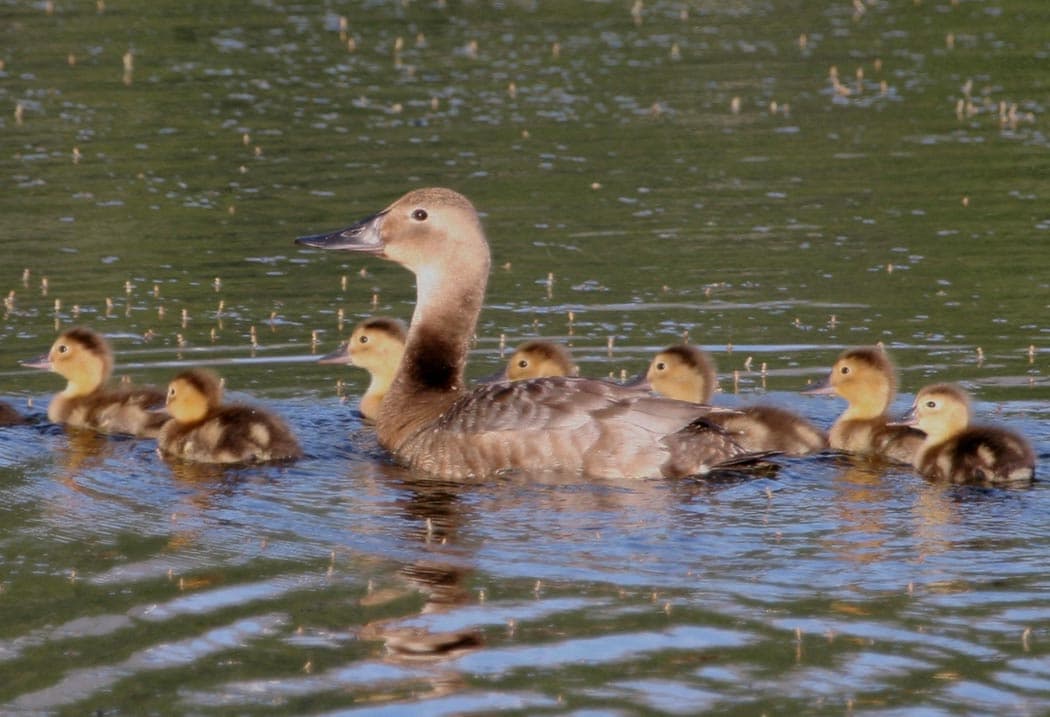
A canvasback hen with ducklings — shown here for identification of the species' distinctive sloped head profile, not as a hunting subject.
Photo by Donna Dewhurst, USFWS, public domain, via Wikimedia Commons. (opens in a new tab)
Drawn from a named source but not independently confirmed. Double-check before relying on it.
Identification/habitat/conservation facts drawn from the Chesapeake Bay Program's own field guide, Maryland DNR, and Ducks Unlimited Canada via live search synthesis across multiple independent sources.
Legal status: A legal migratory game bird in Virginia during the open duck season, under the general duck bag limit — no canvasback-specific sub-limit was found in this project's DWR research for the current season, but verify directly before hunting, since diving-duck sub-limits can and do change between seasons.
North America's largest diving duck, and a signature wintering species of the Chesapeake Bay — long closely associated with the Bay's underwater grass beds.
Field marks
- Distinctive sloped, wedge-shaped head profile — the forehead and bill form one continuous straight line, unlike the more rounded head of a redhead or scaup.
- Long, slender black bill.
- Bright red eyes.
Male, female, and seasonal plumage
- Male
- White body, black chest and tail, chestnut-red head during the breeding season.
- Female
- Brownish head and chest with a whitish body and brownish tail — same distinctive sloped-head profile as the male.
- Habitat
- Large, open bodies of water — the Chesapeake Bay is one of the species' most important wintering areas continent-wide, alongside the Mississippi Delta and San Francisco/San Pablo Bays.
- Feeding behavior
- Dives to feed on the leaves, buds, and roots of submerged aquatic vegetation, especially wild celery — historically a defining link between this species and Chesapeake Bay grass-bed health. Can dive to depths exceeding 5 meters, though it typically feeds shallower.
- Flight profile
- Fast, direct flight typical of diving ducks, often in long lines or V-formations over open water.
Migration & seasonal context
A long-distance migrant from northern prairie and boreal breeding grounds to Atlantic, Gulf, and Pacific coastal wintering areas; the Chesapeake Bay population is watched closely as an indicator of Bay grass-bed (submerged aquatic vegetation) health.
Conservation context
Population and Bay presence tied closely to the health of submerged aquatic vegetation beds, which have themselves fluctuated with Chesapeake Bay water-quality trends over recent decades — a species whose local abundance says as much about Bay habitat condition as about the bird itself.
Similar species — check before you shoot
Identification alone never establishes that a bird may legally be taken. Confirm species (and sex, where a sub-limit depends on it) before shooting.
This page is educational and does not certify that any specific bird may be legally taken at any specific time or place. Always confirm the current season, bag limit, and permit requirements at Licensing & Regulations →