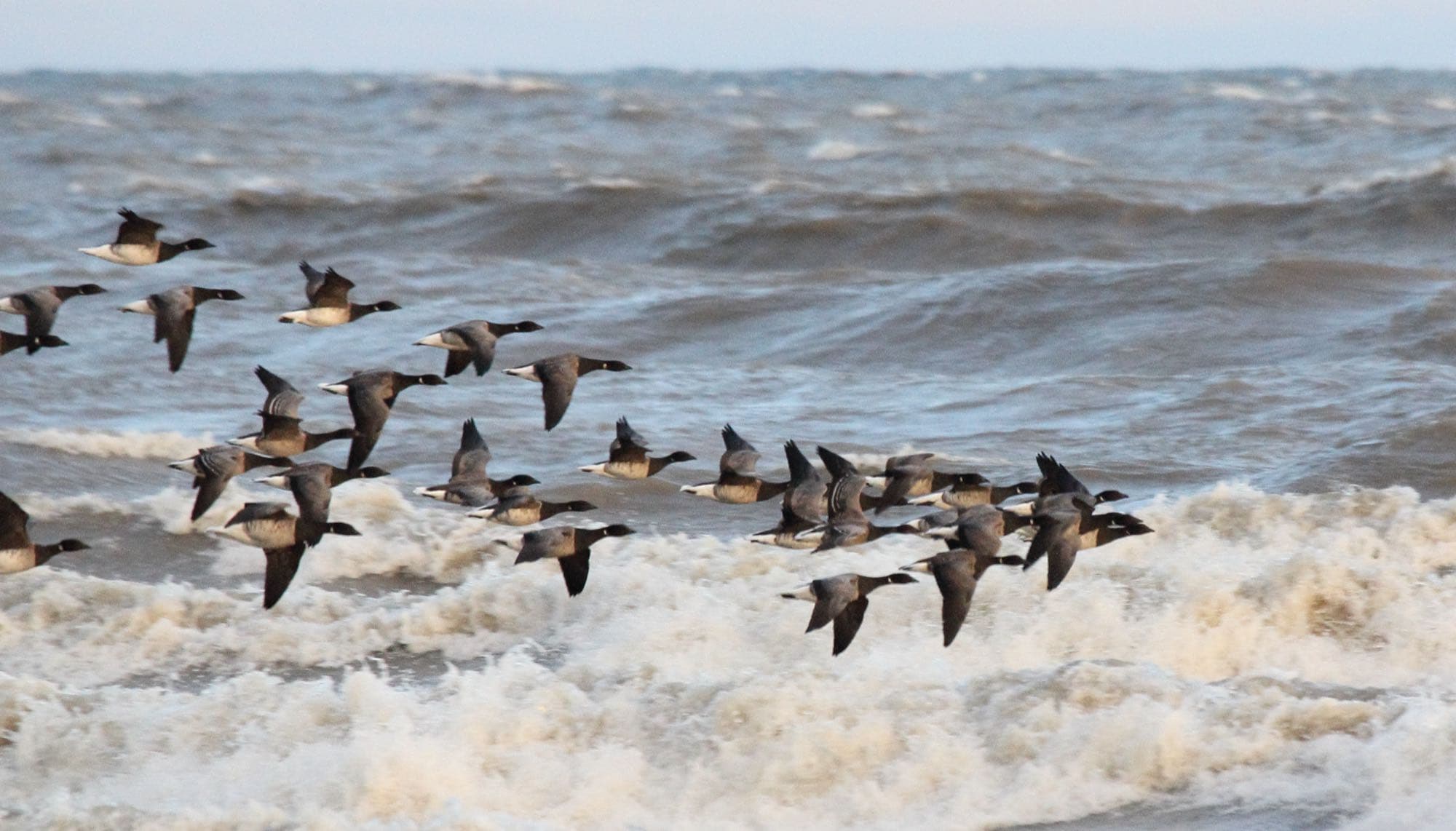
Atlantic Brant
Branta bernicla hrota
Drawn from a named source but not independently confirmed. Double-check before relying on it.
Identification/habitat/eelgrass-restoration facts drawn from the Chesapeake Bay Foundation, Audubon's own reporting on the Virginia seagrass restoration project, and Ducks Unlimited via live search synthesis across multiple independent sources — not a single direct fetch. Legal-status specifically flagged unresolved: this project's own seasons.ts does not yet contain a dedicated Atlantic Brant HuntingSeason record.
Legal status: A legal migratory game bird under federal frameworks, with its own dedicated Virginia season distinct from the general duck season — see this project's seeded atlantic-brant-2026-2027 HuntingSeason record (two splits, December 19-31 and January 15-31, 1-bird daily/3-bird possession limit, directly DWR-sourced) — verify current dates and limits directly with DWR before hunting brant.
A small, dark sea goose of coastal bays — distinct from Canada goose in both size and habitat, historically tied to eelgrass beds and now recovering on Virginia's Eastern Shore as those beds are restored.
Field marks
- Black head, neck, and breast (no white chinstrap, unlike Canada goose) with a small white neck-band flecking on adults.
- Noticeably smaller and more compact than a Canada goose, with a shorter neck and stubbier bill.
- A distinctive guttural, rolling honk quite unlike a Canada goose's call.
- Habitat
- Shallow saltwater coves, bays, and lagoons with submerged aquatic vegetation — historically dependent on eelgrass, which crashed across much of its range decades ago.
- Feeding behavior
- Feeds primarily on eelgrass, sea lettuce, and other intertidal/submerged plants — a specialist diet distinct from the grass/grain grazing typical of Canada and snow geese.
- Flock behavior
- Highly gregarious on wintering grounds, forming dense rafts on open water and shallow bays rather than the field-grazing flocks typical of Canada geese.
Migration & seasonal context
Winters from southern New Jersey through North Carolina's Outer Banks, with Virginia's Eastern Shore roughly in the middle of that range — arriving in fall and remaining until early spring.
Conservation context
Largely absent from the Atlantic coast south of Long Island for more than half a century after regional eelgrass die-offs eliminated its primary food source; recent large-scale eelgrass restoration on Virginia's seaside bays (a real, ongoing VIMS-linked program) has brought wintering brant back to the Eastern Shore — a documented conservation success story tied directly to habitat restoration, not population management alone.
Similar species — check before you shoot
Identification alone never establishes that a bird may legally be taken. Confirm species (and sex, where a sub-limit depends on it) before shooting.
This page is educational and does not certify that any specific bird may be legally taken at any specific time or place. Always confirm the current season, bag limit, and permit requirements at Licensing & Regulations →