Soft-Shell Clam
Mya arenaria
Drawn from a named source but not independently confirmed. Double-check before relying on it.
Historical decline and biology corroborated across multiple independent Chesapeake-region sources found via WebSearch (Chesapeake Bay Program, VIMS, Bay Journal); no single, current, Virginia-specific recreational regulation was directly confirmed for this species distinct from the general hard-clam-oriented VMRC page — stated as an open gap rather than assumed.
Legal status: This guide's own research found VMRC's general recreational "clam" limit (250/day, hand or ordinary tong, from open areas) worded broadly enough to plausibly include this species, but did not find a soft-shell-clam-specific confirmation, and the practical fishery itself is now a small remnant of its historical scale after decades of decline. Verify directly with VMRC before targeting this species specifically.
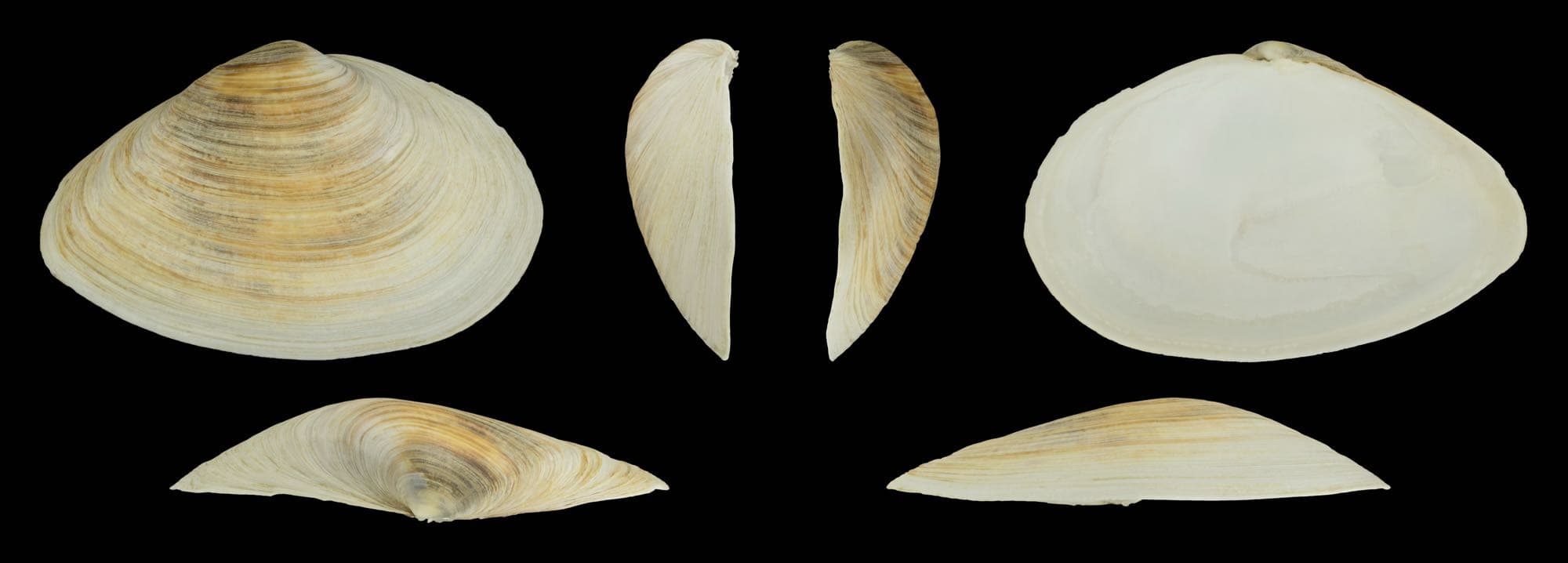
An elongated, thin-shelled clam that cannot fully close its shell around its long siphon (hence "soft-shell") — distinct from the thick-shelled hard clam.
Identification
- Thin, brittle, elongated oval shell, unlike hard clam's thick heavy shell.
- A long siphon that prevents the shell from closing completely.
- Buries deeper in soft mud than hard clam typically does.
- Regional occurrence
- Historically widespread in the middle Chesapeake Bay, including Virginia waters, but the fishery has declined sharply over the past three decades due to disease and other pressures — remnant populations and a much-diminished fishery remain.
- Habitat
- Buries deep in soft mud/sand in brackish tidal water.
- Food use
- Eat With Caution
Similar species — check before you keep one
Identification alone never establishes that an animal may legally be kept. Confirm species before harvesting.
Consumption advisory
Data not yet verified.
This site hasn't checked for a fish-consumption advisory covering this species yet. That is not the same as confirmed safe — check current official guidance before eating your catch.
This page is educational and does not certify that any specific animal may be legally harvested at any specific time or place. Confirm current regulations, health-closure status, and access rights before harvesting.