Northern Pintail
Anas acuta
Drawn from a named source but not independently confirmed. Double-check before relying on it.
Identification/population facts drawn from USFWS's own December 2024 Bird of the Month feature and Cornell's All About Birds via live search synthesis. This project separately found, via DWR search results only (not a direct fetch of a bag-limit breakdown specific to pintails for the season seeded in seasons.ts), a note that the pintail daily limit rose from 1 to 3 in a recent season — that specific figure was NOT independently confirmed via direct fetch during this build and is deliberately not asserted as this project's own bag-limit record; see the Duck Season entry's general bag limit and verify the species-specific figure directly with DWR before hunting pintail.
Legal status: A legal migratory game bird in Virginia during the open duck season, under the general duck bag limit (no separate named sub-limit reported by DWR's own page as of this project's most recent check — verify the current season's own bag-limit breakdown directly, since sub-limits for individual species do change between seasons; DWR's own recent guidance has specifically flagged a pintail bag-limit change in a prior season).
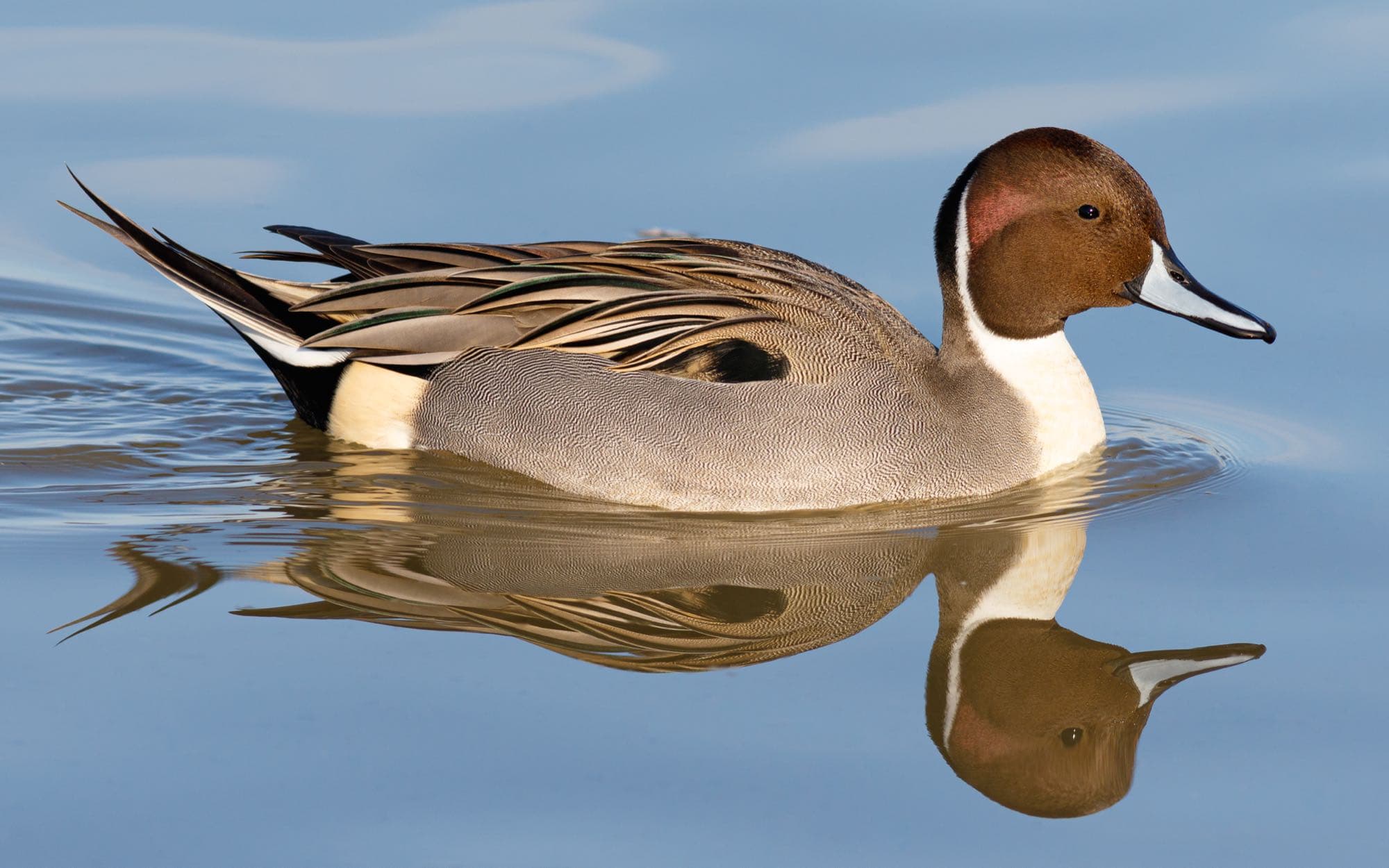
An elegant, long-necked, slender dabbling duck — among the most easily identified ducks in silhouette alone, thanks to the male's long pointed tail.
Field marks
- Long, slender neck and pointed tail — much more pronounced on breeding males than on females or eclipse males.
- Overall slim, elongated body profile distinct from the more compact mallard or teal.
Male, female, and seasonal plumage
- Male
- Gleaming white breast with a white line running up the side of a chocolate-brown head and neck; long central tail feathers ('pintail').
- Female
- Mottled brown overall with a plain, unmarked pale tan face and a dark bill; shorter tail than the male but still slimmer-necked than a hen mallard.
- Eclipse plumage
- Males in molt resemble females — mottled brown, unmarked tan face — but retain a slimmer build and grayer bill tone.
- Habitat
- Shallow wetlands, flooded agricultural fields, and open marsh — prefers more open water than teal or wood ducks.
- Feeding behavior
- Dabbles and tips up for seeds (including waste grain in flooded fields), aquatic vegetation, and invertebrates.
- Flight profile
- Fast, direct flight on narrow, pointed wings; the long neck and tail are visible even at distance.
Migration & seasonal context
Atlantic Flyway wintering pintails are a mix of birds from eastern Canadian and prairie-pothole-region breeding grounds. Population has fluctuated significantly with drought cycles on the breeding grounds; the 2025 State of the Birds report lists the species as a 'Yellow Alert Tipping Point' species (over 50% population loss in the past 50 years, though recent trends are comparatively stable). USFWS's spring 2024 breeding-population estimate was roughly 2.2 million, against a long-term average near 3.8 million.
Conservation context
Long-term population decline driven substantially by prairie-pothole wetland loss and drought on the primary breeding grounds — a species worth watching rather than assuming abundant, even though it remains a legal, commonly-encountered species on the Atlantic coast in winter.
This page is educational and does not certify that any specific bird may be legally taken at any specific time or place. Always confirm the current season, bag limit, and permit requirements at Licensing & Regulations →