Long-tailed Duck
Clangula hyemalis
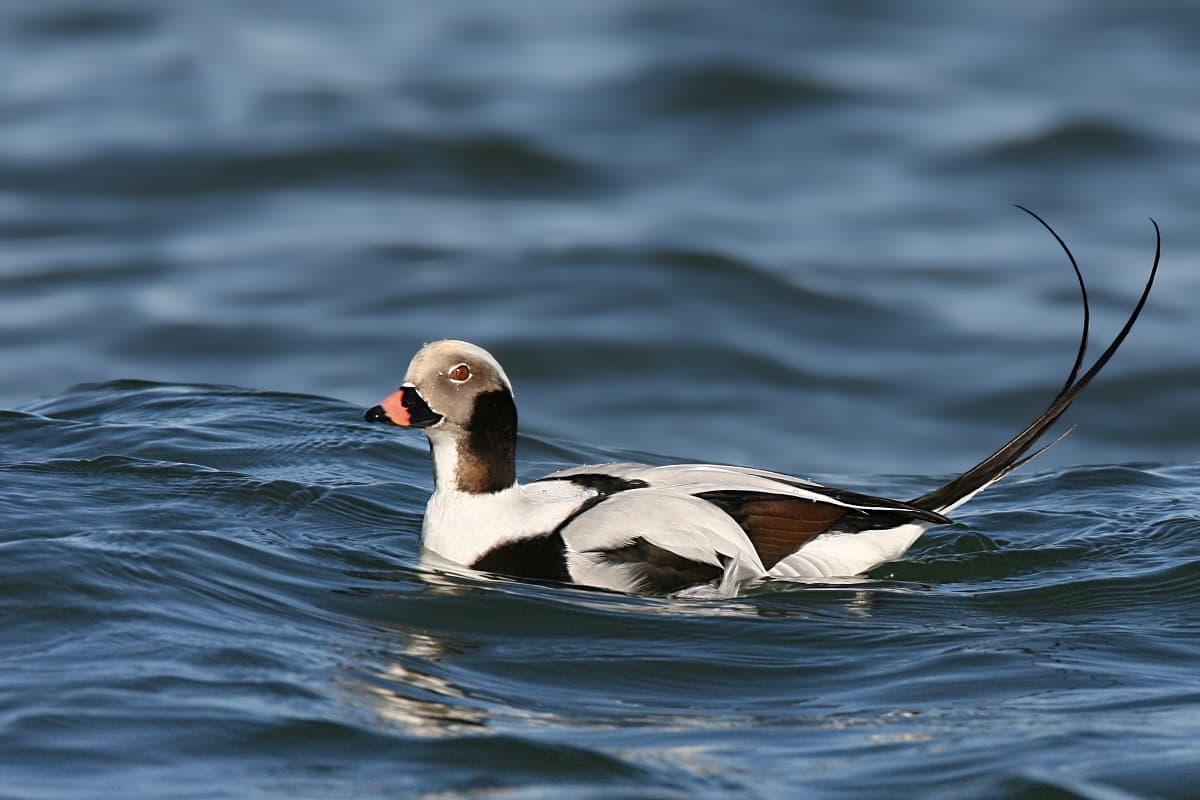
Drawn from a named source but not independently confirmed. Double-check before relying on it.
Identification facts drawn from Ducks Unlimited and BTO via live search synthesis. The genuine disagreement about Virginia occurrence frequency is preserved explicitly in this record's own migrationContext rather than resolved by picking one source over the other — see Bay Journal's 'On the Wing' column and the Virginia Society of Ornithology's own characterization, both found during research and both stated.
Legal status: A legal migratory game bird, hunted during Virginia's regular duck season (not a separate sea-duck season) under a combined sea-duck sub-limit — DWR's own page: "4 total sea ducks (no more than 3 scoters, 3 eiders [only 1 hen], 3 long-tailed ducks)" — see the seeded ducks-2026-2027 HuntingSeason record. That legal framework is confirmed; how often a hunter would realistically encounter this species in Virginia waters at all is the separate, genuinely unresolved question addressed above — treat any Virginia sighting or harvest as notable, not routine, and confirm identification carefully.
A distinctive, boldly-patterned Arctic-breeding sea duck that winters offshore — genuinely uncommon in Virginia relative to its more regular presence further north, so its seasonal status here is stated cautiously rather than assumed.
Field marks
- Males show unusually long, pointed central tail feathers, the source of the name — visible on the water and in flight.
- A complex, seasonally-changing plumage pattern of black, white, and gray unlike any other locally-possible duck.
- Small, rounded head with a stubby bill.
- Habitat
- Open, often far-offshore ocean waters and large coastal bays.
Migration & seasonal context
Breeds on Arctic tundra and winters along northern Atlantic and Pacific coastlines. Regional sources genuinely disagree on how expected this species is as far south as Virginia: some describe it as regular (if uncommon) south to Virginia on the Atlantic coast, while the Virginia Society of Ornithology has characterized it as a rare find in the state. This page states both rather than picking the more convenient answer — treat any Virginia sighting or harvest as notable, not routine.
Ethical shot selection: Given the real uncertainty about how commonly this species actually occurs in Virginia, confirm identification with particular care before taking a shot at what might be this species — a misidentification here has real conservation stakes given how uncommon regional records suggest it may be.
This page is educational and does not certify that any specific bird may be legally taken at any specific time or place. Always confirm the current season, bag limit, and permit requirements at Licensing & Regulations →