Harlequin Duck
Histrionicus histrionicus
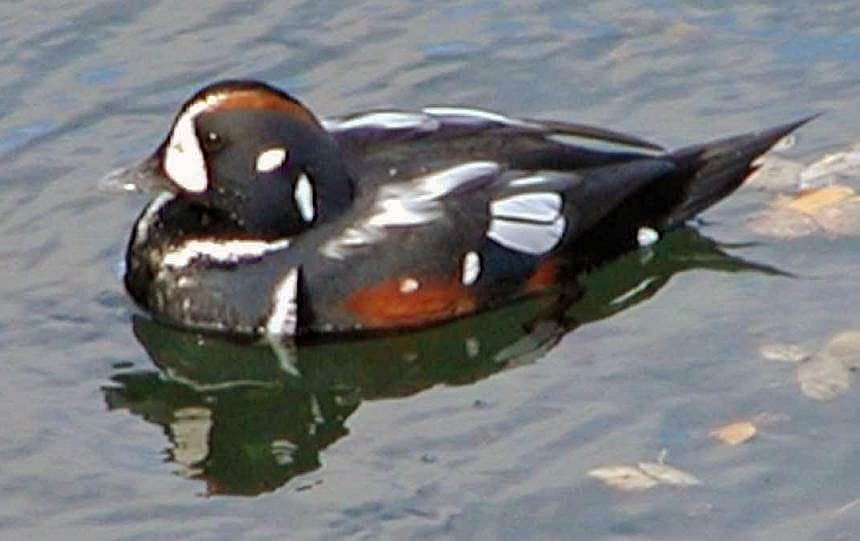
Part of this record is confirmed against an official source; other parts are not. See the notes below for exactly which.
Male/female identification features and the eastern-range harvest-prohibited status are directly confirmed against Ducks Unlimited's own waterfowl-ID page. The specific 2025 Rudee Inlet sighting (3 birds, 1 male/2 females) and the CBBT's own reliability as a Virginia sighting location are directly confirmed via regional birding-journal coverage (Beach Birding) — real, dated, location-specific records, not a bare range claim. classification kept as 'sea-duck' rather than 'similar-protected-non-target-species' since it genuinely is a sea duck, not a different bird family being flagged as a lookalike — foodUseStatus and legalStatus carry the actual protected-status information instead.
Legal status: Harvest is prohibited across the entire eastern portion of this species' range — which includes Virginia and the whole Atlantic Flyway — per Ducks Unlimited's own species page; only limited subsistence harvest occurs in Alaska/Canada, entirely outside this region. Never a legal Virginia target regardless of season or sub-limit. Included in this guide for identification/safety context, not as a huntable species.
A small, strikingly patterned sea duck of rocky coasts — genuinely rare in Virginia, but with real, specific, recent records at Rudee Inlet and the Chesapeake Bay Bridge-Tunnel. Harvest is prohibited across the entire eastern portion of this species' range, including Virginia.
Field marks
- Male: slate-blue body bordered by black lines on the head/chest, a large white crescent in front of the eye, a small white dot behind the eye, a white vertical stripe on the neck/shoulder, and rich chestnut-brown flanks.
- Female: slate-brown overall with a brown head, a triangular white patch from below/forward of the eye to the bill, and a small round white dot behind the eye.
- Small-bodied compared to other regional sea ducks, typically found on rocky structure (jetties, inlet rocks) rather than open water.
- Habitat
- Rocky, intertidal structure — jetties and inlet rock structure. The Chesapeake Bay Bridge-Tunnel and Rudee Inlet are among the more reliable Virginia locations.
Migration & seasonal context
Genuinely rare this far south — a real 2025 record documented three harlequin ducks (one adult male, two females) foraging inside Rudee Inlet, described by regional birders as a surprise in a season where the species had been 'essentially nonexistent' south of the Chesapeake Bay. Winters in the north Atlantic from Greenland to the Chesapeake Bay, putting Virginia at the southern edge of its regular winter range.
Ethical shot selection: Never treat a small, boldly-patterned sea duck on rocky structure as a legal target without being certain it isn't this species — harvest is prohibited here regardless of any duck season's own general bag limit.
This page is educational and does not certify that any specific bird may be legally taken at any specific time or place. Always confirm the current season, bag limit, and permit requirements at Licensing & Regulations →