Bufflehead
Bucephala albeola
Drawn from a named source but not independently confirmed. Double-check before relying on it.
Identification/habitat facts drawn from Cornell's All About Birds and Birds of the World via live search synthesis. `foodUseStatus` set to eat-with-caution rather than commonly-eaten, reflecting general hunter-education guidance that small, primarily-fish/invertebrate-eating diving ducks like bufflehead often have stronger, less broadly palatable meat than dabbling ducks — a culinary generalization, not a food-safety/contaminant claim; see the food-safety topic content for the distinction.
Legal status: A legal migratory game bird in Virginia during the open duck season, under the general duck bag limit — verify the current season's specific diving-duck sub-limit structure, if any, directly with DWR before hunting.
North America's smallest diving duck — a compact, fast-flying, and unmistakable bird once its bold head pattern is seen.
Field marks
- Very small and compact compared to any other diving duck likely to be seen in the same water.
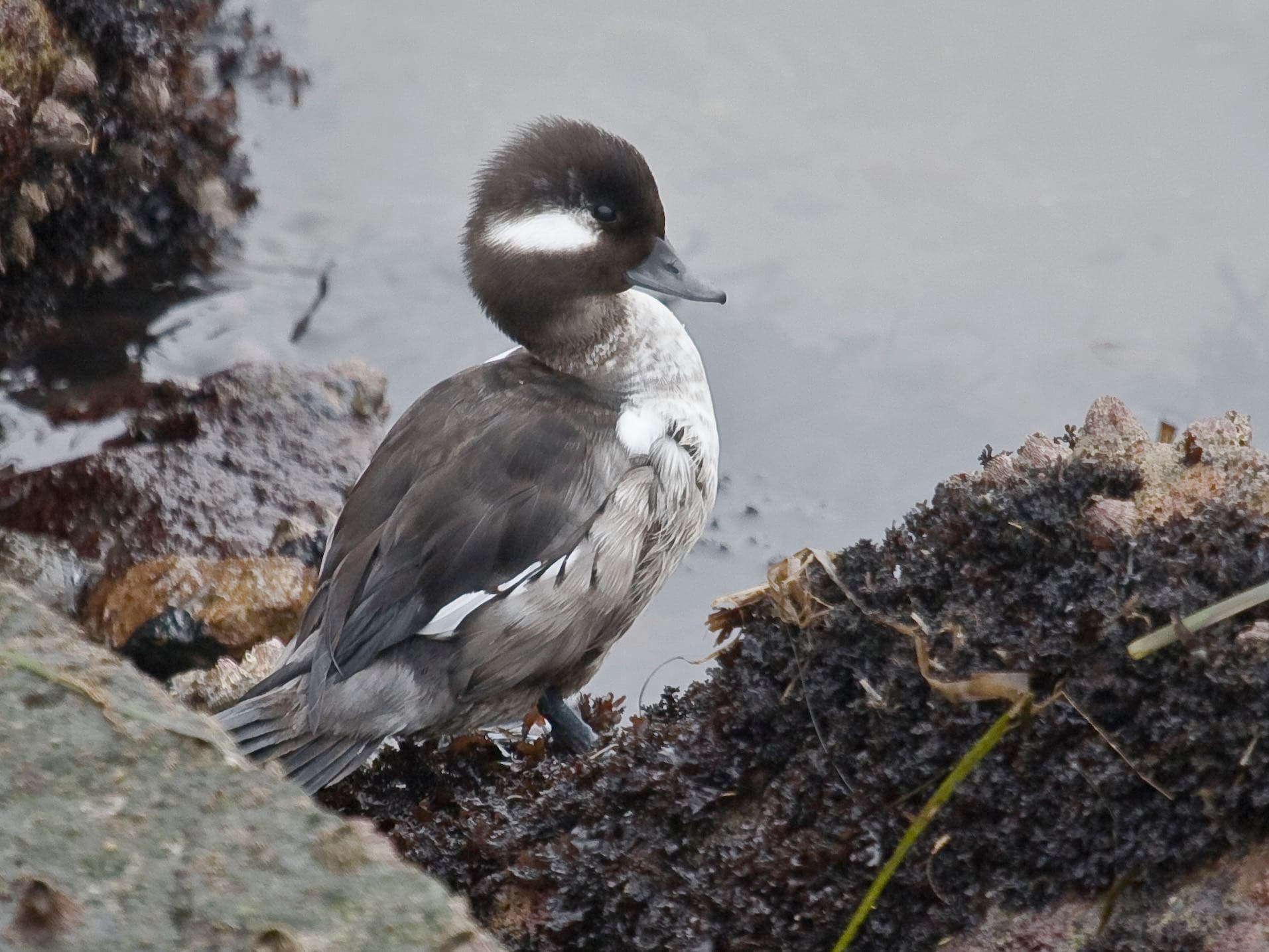
- Large, puffy head shape relative to body size — the name derives from 'buffalo-head.'
Male, female, and seasonal plumage
- Male
- Striking black-and-white body with a large white patch wrapping the back of an iridescent purple-green head.
- Female
- Gray-brown overall with a small, elongated white patch below and behind the eye.
- Habitat
- Ponds, lakes, coastal bays, and sheltered inlets in winter.
- Feeding behavior
- Dives for aquatic invertebrates (insects, mollusks, crustaceans) and small fish, especially in winter.
- Flight profile
- Fast, low, whirring flight — often flushes and flies in small, tight groups.
Migration & seasonal context
Breeds in the boreal forest and aspen parkland of Canada and Alaska, wintering across much of the continental U.S. coastline, including Hampton Roads' sheltered coastal and estuarine waters.
Conservation context
Population considered stable; its small size and reliance on old woodpecker cavities for nesting (it is too small to compete for larger cavities other ducks need) is a notable, unusual life-history trait for a diving duck.
This page is educational and does not certify that any specific bird may be legally taken at any specific time or place. Always confirm the current season, bag limit, and permit requirements at Licensing & Regulations →